Look 1: The Overpacked Morning Block That Sets the Tone
Quick Answer: Many retreat schedules pack back-to-back activities from early morning through evening with minimal true unstructured downtime, mistaking a full calendar for a valuable one — genuine rest requires unscheduled time to actually integrate and recover from activities, so a retreat that looks impressively packed on the itinerary can leave attendees more depleted than relaxed by the final day, even if every individual activity was itself enjoyable.
A retreat’s value isn’t measured by how full its schedule looks — it’s measured by whether there’s genuine room built in for the nervous system to actually downshift between activities.

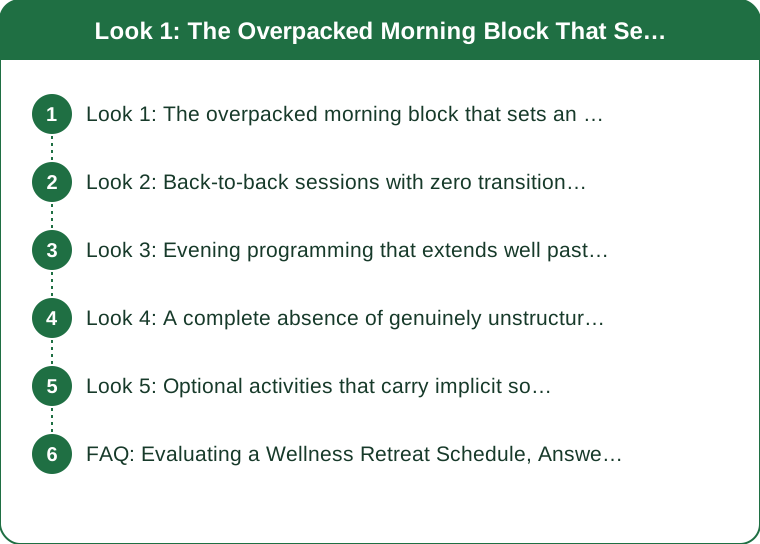
Look 1: The overpacked morning block that sets an exhausting tone for the whole day.
Many retreats schedule an early wake-up followed immediately by a full activity block — yoga, a hike, a workshop — with no buffer time before the day’s structured programming begins in earnest. This front-loaded pace signals to the nervous system that the day is another full sprint, working against the recovery mindset a retreat is meant to support, even before lunch.
Look 2: Back-to-back sessions with zero transition time between them.
Scheduling one session to end exactly when the next begins, without any built-in transition or buffer, means attendees are constantly rushing from one activity to the next rather than having a moment to process or simply rest between them. A schedule with even 15-30 minutes of unstructured buffer between major activities meaningfully changes how restorative the same set of activities actually feels.
Look 3: Evening programming that extends well past a natural wind-down time.
Retreats that schedule substantial programming (group activities, late dinners, evening workshops) extending past 8 or 9pm work against the body’s natural evening wind-down process, which is a core part of what supports genuinely restorative sleep. A schedule with evening programming ending earlier, leaving real personal wind-down time before bed, better supports the actual physiological rest a retreat is meant to provide.

Look 4: A complete absence of genuinely unstructured, unscheduled time.
Some retreat schedules fill every single time block with a named, structured activity, leaving no room for spontaneous rest, journaling, or simply doing nothing — yet unstructured time is often where the deepest psychological rest and integration actually happens, distinct from the value of the structured activities themselves. A schedule without any blank space at all is a meaningful red flag worth checking for before booking.
Look 5: Optional activities that carry implicit social pressure to attend anyway.
Even when a retreat schedule technically labels certain activities as “optional,” group social dynamics can create real pressure to attend anyway, effectively erasing the rest value that opting out was supposed to provide. Retreats that explicitly and repeatedly normalize opting out, rather than just technically allowing it, more genuinely protect attendees’ actual rest time.
FAQ: Evaluating a Wellness Retreat Schedule, Answered
What’s a reasonable amount of unstructured time to look for in a retreat itinerary before booking?
While it varies by retreat style, many experienced retreat-goers look for at least 2-3 hours of genuinely unstructured time somewhere in the daily schedule, not just during designated meals.
Is it reasonable to ask a retreat organizer directly about the schedule’s pacing before booking?
Yes, this is a completely normal and increasingly common question, and a retreat organizer’s willingness to discuss pacing specifics honestly is itself a useful signal about the retreat’s actual priorities.
Does retreat length (a weekend versus a full week) change how much this scheduling concern matters?
A shorter retreat often has less room for genuine downtime by design, making schedule pacing an even more important factor to check carefully, compared to a longer retreat that has more natural room to space activities out.
TL;DR:
- Overpacked morning blocks and back-to-back sessions leave little room for genuine nervous system rest
- Evening programming extending too late works against natural sleep wind-down processes
- A complete absence of unstructured time removes the space where real psychological integration happens
- Implicit social pressure around “optional” activities can quietly erase intended rest time
A retreat’s schedule structure, more than its list of individual activities, determines whether attendees leave genuinely rested — checking for real unstructured time before booking is worth the extra step.
Keep Reading
This article is for general informational and styling purposes only. Fit, sizing, and product availability may vary.