5 Retreat Booking Details That Decide Whether the Week Works
Quick Answer: Five booking details predict retreat satisfaction better than the itinerary does: group size, travel time on arrival day, room type and sleep quality, what the food actually is, and how much of the schedule is optional. All five are answerable before you pay, and all five are things people notice only once they are already there.
Two people book the same retreat. One comes home genuinely restored; the other comes home tired and slightly disappointed.
The difference is almost never the yoga, the setting or the teacher. It is a set of practical details that never appear in the photographs.
Here are the five worth checking before anything else.

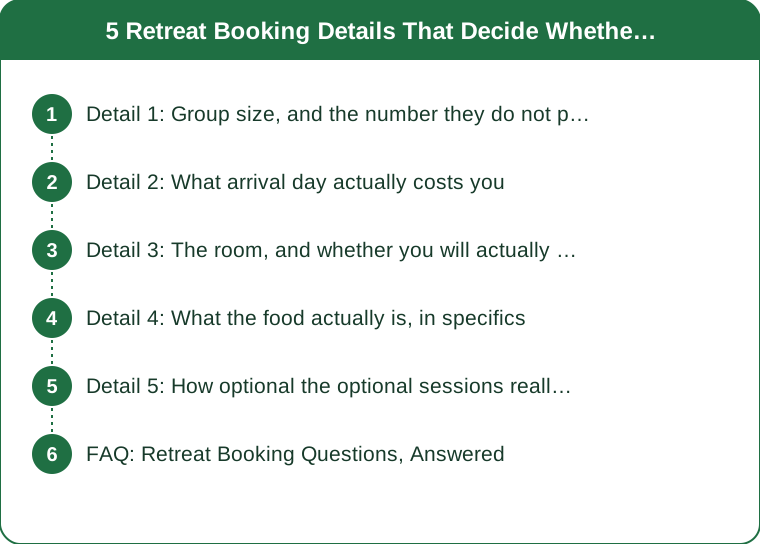
Detail 1: Group size, and the number they do not print
Group size changes the entire character of a week, and it is the detail most often left vague.
Under 10 people produces a genuinely intimate experience with individual attention, but there is nowhere to hide socially. If the group does not gel, or if you want time alone, a very small group can feel intense.
10 to 18 is the range most people find comfortable — enough variety to find your people, small enough that the teacher knows your name and can adjust for you.
Over 20 starts to become a course rather than a retreat. Class instruction becomes general rather than individual, meals become logistics, and the quiet time you came for is harder to find.
The question to ask directly: not “how many people” but “how many were on your last three retreats”. Advertised capacity and actual attendance can differ substantially, and the answer to the second question tells you what your week will actually feel like.
Also worth asking: how many teachers or facilitators there are per participant, and whether the group is fixed for the week or people come and go on different schedules. A rolling group changes the social dynamic completely.
Detail 2: What arrival day actually costs you
The single most underestimated element of any retreat.
A retreat that requires a long-haul flight, a transfer and a winding drive means day one is spent recovering from travel, not resting. On a five-day retreat that is 20% of the experience gone before it starts.
Work out the real door-to-door time, including the transfer from the airport, which is often 90 minutes or more for rural properties.
Rough guidance:
- Under 3 hours total: you arrive able to participate the same day.
- 3 to 6 hours: you will want the first evening quiet; plan accordingly.
- Over 6 hours or any flight with a time change: budget a full day at each end, and consider whether a shorter retreat closer to home would deliver more actual rest.
The related question: what time does the programme start on day one, and what time does it end on the final day? A retreat that begins with dinner on day one and ends after breakfast on day five is considerably shorter than the advertised five days.
Detail 3: The room, and whether you will actually sleep
Sleep is the mechanism through which a retreat works, and it is treated as an afterthought in most booking pages.
Shared versus private is the obvious question, and the price difference is often smaller than people assume. If you sleep lightly, the single supplement is the highest-value money you will spend on the whole trip.
Less obvious things worth asking about:
- Bathroom arrangement. Ensuite versus shared changes how well you sleep, particularly in a shared room.
- Blackout and noise. Rural properties can be surprisingly noisy at dawn, and many have no blackout curtains at all.
- Heating and cooling. A beautiful stone building can be genuinely cold at night in autumn, and many have no air conditioning in summer.
- Proximity to communal spaces. A room above the dining room or beside the studio is a different experience from one at the end of a corridor.
The practical move: ask for photographs of the actual room category you are booking, not the property’s best room. The gap between them is where most disappointment lives.

Detail 4: What the food actually is, in specifics
“Nourishing plant-based cuisine” describes an enormous range of possible weeks.
Three questions produce clarity:
How many meals, and what happens between them? Some retreats serve three meals with nothing available in between. If you train in the morning or have any blood sugar sensitivity, that matters a great deal.
Is there protein at each meal, and how much? Plant-based retreat catering is often carbohydrate-heavy. If you are physically active during the week — yoga twice a day is real physical work — inadequate protein leaves you flat by day three.
How are dietary requirements actually handled? There is a large difference between a kitchen that adapts the main dish and one that produces a separate, obviously improvised plate. Ask what they did for the last person with your requirement.
One more worth asking: whether caffeine and alcohol are available. Some retreats remove both without saying so clearly in advance, and an unplanned caffeine withdrawal headache on day two is a genuinely miserable way to spend a retreat you paid for.
Detail 5: How optional the optional sessions really are
This is where a restorative week becomes an exhausting one.
A packed schedule looks like value. In practice, a retreat with 6:30am meditation, two yoga sessions, a workshop and an evening activity is a full working day of structured commitments.
Three questions:
How much genuinely unstructured time is there per day? Two to three hours of true free time is a reasonable minimum. Less than that and you have booked a course.
What happens socially if you skip a session? Some retreats are warmly relaxed about this. Others create a subtle expectation that makes opting out uncomfortable. Ask directly how many people typically skip the early session.
Is there anywhere to be alone? A property with a library, a garden bench or a quiet room is very different from one where the only spaces are your bedroom and the communal areas.
The honest test: look at the sample schedule and count the hours you would actually be free. Then ask yourself whether that is more or less free time than a normal weekend at home. Surprisingly often, it is less — and that is worth knowing before you pay.
FAQ: Retreat Booking Questions, Answered
How far in advance should I book?
Popular small retreats fill 3 to 6 months out. Booking early also gives you room choice, which — per detail three — matters more than most people expect.
Is a shorter retreat closer to home better than a longer one far away?
Very often, yes. A four-day retreat two hours from home can deliver more actual rest than a week that costs two days of travel at each end.
What if I book and the group turns out to be much larger?
Ask about the cancellation and change policy before booking, specifically what happens if the group size changes materially from what was described. A retreat confident in its numbers will answer this readily.
Should I book a retreat alone or with a friend?
Solo attendance is common and most retreats are structured for it. Going with a friend guarantees company but can limit how much you engage with the group — which is usually where the value is.
TL;DR:
- Group size — ask how many attended the last three, not the advertised capacity.
- Arrival day — calculate real door-to-door time; over six hours costs you a day at each end.
- The room — the single supplement is often the best money on the trip; ask about blackout, noise and heating.
- The food — meals per day, protein at each, and how dietary requirements are genuinely handled.
- Optional sessions — count the genuinely free hours and check whether skipping is socially comfortable.
The setting sells the retreat. These five details decide whether you come home rested or just relocated.
Keep Reading
This article is for general informational and styling purposes only. Fit, sizing, and product availability may vary.