What a Wellness Retreat Day Actually Looks Like, Hour by Hour
Quick Answer: A typical wellness retreat day runs from an early morning practice around 6:30 or 7, through a light breakfast, a substantial morning session, a long unstructured afternoon, an optional late-afternoon class, dinner, and an evening wind-down. The part most first-timers are unprepared for is the afternoon gap, which is deliberately unstructured and is where most of the actual rest happens.
People book retreats imagining continuous activity and arrive to find something closer to the opposite. Here is what each block actually contains.

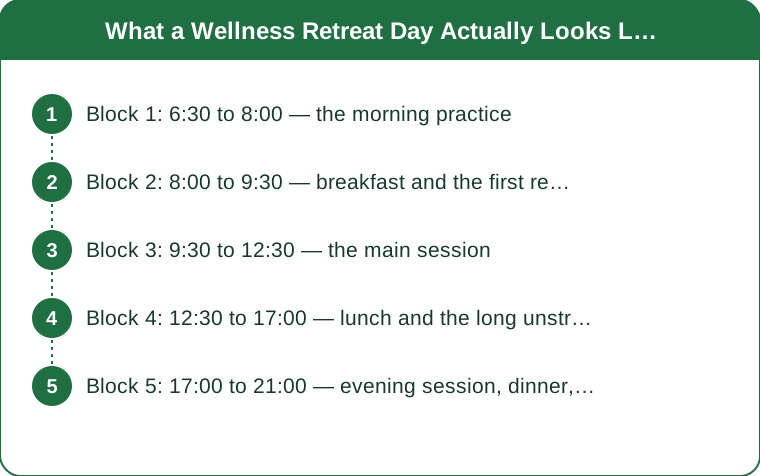
Block 1: 6:30 to 8:00 — the morning practice
The day almost always opens with movement or stillness before food, and this is the block that sets the tone for everything after it.
What it usually is: gentle yoga, a meditation sit, a breathwork session, or a silent walk. Rarely anything strenuous, because the intention is to wake the body rather than to train it.
What it feels like on day one: early, and slightly resented. Most people arrive carrying a sleep debt and a full mind, and a 6:30 start on the first morning is genuinely hard.
What it feels like by day three: the reason people book retreats. The combination of early light, movement before input, and no phone tends to produce a quality of attention that is difficult to manufacture at home.
The practical detail nobody mentions: it is usually cold. Early morning practice spaces, particularly open-sided ones in warm climates, are cooler than the daytime temperature suggests, and the single most useful thing in your bag is a layer you can put on and take off during a session.
Attendance is generally optional, and skipping it once is fine. Skipping it every day tends to leave people feeling out of step with the rhythm of the group, because this block is where the social shape of the week forms.
Block 2: 8:00 to 9:30 — breakfast and the first real conversation
Breakfast is normally served after the first practice rather than before, which is a deliberate choice and one that surprises people.
What it usually is: a buffet with fruit, grains, eggs or a plant protein, and something warm. Portions tend to be modest by design, and there is usually significantly less coffee available than a caffeine-dependent guest would like.
What it feels like: this is where the group actually meets. The morning practice is quiet and often silent, so breakfast on day one is the first genuine social contact, and it sets whether the week feels warm or awkward.
What to know in advance: caffeine reduction is a common feature of retreat menus, and if you normally drink several cups a day, tapering before you arrive prevents a day-two headache that people frequently mistake for detoxification.
The timing detail that matters: the gap between the early practice and breakfast is often two hours, and arriving at the morning session having eaten nothing since dinner is difficult for some people. A small piece of fruit or a few nuts before the practice is usually acceptable and worth asking about.
Many retreats also use breakfast as the announcement point for the day’s schedule changes, so it is worth being there even if you are not hungry.

Block 3: 9:30 to 12:30 — the main session
The morning is where the substantive content lives, and it is the longest structured block of the day.
What it usually is: depends entirely on the retreat type. A yoga retreat runs a long asana practice. A wellness or health retreat runs workshops, talks, or one-to-one consultations. A hiking or active retreat runs the main walk. A silent retreat runs extended sitting periods.
What it feels like: this is where the physical demand actually is, and it is more than people expect. A three-hour block, even a gentle one, is considerably more activity than most guests do at home, and cumulative fatigue across three or four days is the norm rather than the exception.
What to plan for: hydration and a snack. Long morning blocks with a light breakfast behind them catch out anyone used to eating more frequently.
The part first-timers underestimate: the emotional component. Extended practice, unfamiliar surroundings, reduced stimulation, and no phone produce a level of internal noise that people are not used to sitting with. Day two or three is commonly the hardest, and this is well documented enough that most good facilitators mention it in advance.
If a session is not working for you, leaving quietly is almost always acceptable and is generally better than staying resentfully. Good facilitators would far rather you step out.
Block 4: 12:30 to 17:00 — lunch and the long unstructured afternoon
This is the block people are least prepared for and the one that does the most work.
What it usually is: lunch, then several hours with nothing scheduled. Optional treatments, a pool, a library, a walk, or a nap. Many retreats deliberately leave this empty.
What it feels like on day one: uncomfortable. People who structure their days tightly at home often find unstructured time genuinely difficult, and the first afternoon commonly produces restlessness, phone-checking, and a vague sense that they should be doing something.
What it feels like by day three: the most valuable part of the week. The rest that people book retreats for happens here rather than in any class.
What to bring for it: a book you actually want to read rather than one you feel you should. A journal, which more people use than expect to. Comfortable clothes for doing nothing in.
The practical note: treatments and massages are usually booked in this window and the good slots go on day one. If a treatment matters to you, book it on arrival rather than waiting.
And the honest advice: resist filling it. The instinct to book something into every afternoon hour defeats the design of the day, and people who do it consistently report leaving less rested than those who did not.
Block 5: 17:00 to 21:00 — evening session, dinner, and wind-down
The evening tapers deliberately, and the structure is designed to move you toward sleep.
What it usually is: an optional late-afternoon class, typically restorative yoga, yin, or a sound session, then dinner, then an optional evening gathering such as a talk, a fire, or a group circle.
What dinner is like: usually the largest meal, often communal at long tables, frequently vegetarian or with a strong plant emphasis, and generally earlier than most people eat at home. That earlier timing is one of the underrated reasons people sleep so well on retreats.
What the evening feels like: quiet, and quieter as the week goes on. Group energy tends to be high on the first night and settles considerably by night three, which is normal rather than a sign that anything has gone wrong socially.
What to know: alcohol is absent at many retreats and limited at most, and lights out is generally early. Both of these contribute substantially to how people feel by day four.
The detail that improves the whole week: keep the phone off through this block specifically. Evening is when the pull back toward normal life is strongest, and the guests who report the biggest benefit are consistently the ones who did not check in each night.
FAQ: Retreat Day Questions, Answered
Is everything mandatory? Almost never. Sessions are optional at the overwhelming majority of retreats, and stepping out of one is normal. Silent retreats and some structured programs are the exception, and they say so clearly.
How much free time is there really? Usually four to five hours in the middle of the day, plus the evening. It is more than most people expect and it is intentional.
Will I be bored? Possibly on day one, and that generally resolves by day two. The discomfort of unstructured time is a common and temporary part of the experience rather than a sign the retreat is wrong for you.
TL;DR:
- Early practice before breakfast, a long morning session, a deliberately empty afternoon, and an early tapering evening
- The afternoon gap is where the actual rest happens; resist the urge to fill it
- Day two or three is commonly the hardest emotionally, and that is normal and expected
- Taper caffeine before you arrive, bring a warm layer for early sessions, and book treatments on day one
Look at the sample schedule before you book, and check the size of the afternoon block. That number tells you more about the retreat than any photograph.
Keep Reading
This article is for general informational and styling purposes only. Fit, sizing, and product availability may vary.