Five Retreat Formats and Who Each One Actually Suits
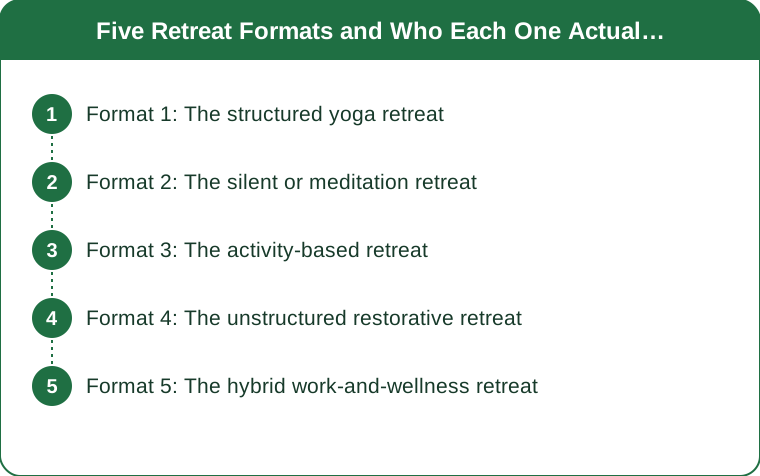
Quick Answer: Retreats fall into roughly five formats: structured yoga, silent or meditation, activity-based, unstructured restorative, and hybrid work-and-wellness. They differ enormously in daily schedule, social contact, and how much choice you get. The single best predictor of enjoyment is whether the structure matches how you personally recover, so someone who recovers through activity will find a silent retreat draining and someone who recovers through stillness will find an activity retreat exhausting.
The brochure photography is close to identical for all five, which is exactly why people book the wrong one.
This blog has covered what a retreat day actually looks like hour by hour and why a retreat schedule can feel more tiring than relaxing. This is the format-by-format version to check before you book.

Format 1: The structured yoga retreat
The daily shape: two practices a day, typically a longer active session in the morning and a slower restorative one in the late afternoon, with meals and free time between. Around three to four hours of scheduled activity a day.
Who it suits: people who already have a practice and want to deepen it, and people who like a predictable frame around their day. The structure removes decisions, which many people find genuinely restful.
Who struggles: complete beginners occasionally find twice-daily practice physically demanding by day three, particularly if the morning session is vigorous. And anyone who wants genuinely open days will find this format busier than expected.
What to check before booking: the style and intensity of the practice, whether attendance is expected or optional, and the teacher-to-guest ratio. A vinyasa retreat and a yin retreat are completely different physical experiences under the same heading.
The common misjudgement is booking on the location and the photography and not checking the style. Someone expecting gentle stretching who arrives at a dynamic practice retreat has a difficult week, and it is entirely avoidable with one question before booking.
Format 2: The silent or meditation retreat
The daily shape: long stretches of silence, multiple seated meditation periods, minimal social interaction, and often early starts. Vipassana-style retreats can run to ten hours of formal practice a day.
Who it suits: people with some existing meditation experience, people who genuinely recharge alone, and people specifically seeking a break from social and digital input rather than from physical activity.
Who struggles: almost everyone finds days two and three difficult, and that is considered part of the process rather than a problem. But people who process by talking, and people going through an acute difficult period, often find it genuinely hard rather than productively hard.
What to check before booking: the amount of daily sitting, whether walking meditation is included, the level of teacher support available, and the policy on leaving early.
The honest warning most brochures do not give is that silent retreats can bring up difficult material without the usual distractions to manage it. This is often the point, and it is worth being prepared rather than surprised. If you are in a period of acute distress or grief, this is worth discussing with a professional before booking.

Format 3: The activity-based retreat
The daily shape: hiking, surfing, cycling, or a similar physical focus, usually with one main activity a day, shared meals, and evenings free. Physically demanding and socially warm.
Who it suits: people who recover through movement and outdoors time rather than through stillness, and people who find unstructured relaxation genuinely uncomfortable. Also excellent for solo travellers, because shared activity builds connection quickly.
Who struggles: anyone arriving genuinely exhausted. A week of daily hiking on top of burnout can deepen it rather than resolve it, and this is the most common mismatch in the whole category.
What to check before booking: the actual daily distances and difficulty, whether there are rest days, and whether opting out of a day is straightforward.
The thing to be honest with yourself about is what you are recovering from. Physical rest and mental rest are different needs. If your work is sedentary and mentally draining, an activity retreat can be genuinely restorative. If you are physically depleted, it is a holiday that will cost you.
Format 4: The unstructured restorative retreat
The daily shape: minimal fixed schedule, optional sessions, treatments available, and long stretches of open time. Often includes spa facilities, good food, and quiet grounds.
Who it suits: people who are genuinely depleted, people who have a clear sense of what they need, and anyone whose ordinary life is over-scheduled. If your problem is too many decisions and too little space, this is the format that addresses it.
Who struggles: people who need external structure to actually rest. A surprising number find open time anxiety-inducing and end up filling it, or spending the week on their phone, which defeats the entire purpose.
What to check before booking: what is actually included versus charged separately, whether there is any communal structure at all, and how isolated the location is if you are travelling alone.
The most common regret with this format is booking a week and finding three days would have been enough. Unstructured time has diminishing returns for most people, and shorter is frequently better here than it is in the other four formats.
Format 5: The hybrid work-and-wellness retreat
The daily shape: dedicated working hours with reliable internet, bracketed by movement, good food, and communal evenings. Increasingly common and genuinely different from the other four.
Who it suits: people who cannot take genuine leave, freelancers and remote workers, and anyone who wants a change of environment rather than a break from work. Also good for people who find complete leisure uncomfortable.
Who struggles: anyone hoping this counts as a proper break. It does not, and expecting it to is the main source of disappointment with the format. It is a better working week, not a rest.
What to check before booking: internet reliability above everything, the working space provided, the time zone relative to your colleagues, and whether the wellness element is genuinely scheduled or theoretical.
The honest assessment is that this format is excellent at what it does and frequently mis-sold as what it is not. If you need actual recovery, take actual leave. If you need a change of scene while continuing to work, this is a well-designed way to do it, and it has quietly become one of the most popular formats for exactly that reason.
A closing point that applies across all five: the format matters more than the destination. A retreat in a beautiful location with the wrong structure for you is a worse week than an ordinary location with the right one.
TL;DR:
- Five formats: structured yoga, silent or meditation, activity-based, unstructured restorative, and hybrid work-and-wellness.
- The best predictor of enjoyment is whether the format matches how you personally recover, through movement or through stillness.
- Be honest about whether you are physically or mentally depleted. An activity retreat deepens physical exhaustion.
- Unstructured retreats have diminishing returns, and three days is often better than seven.
Check the daily schedule before the photography. The format decides the week far more than the location does.
Keep Reading
This article is for general informational and styling purposes only. Fit, sizing, and product availability may vary.