5 Signs Your Wellness Retreat Itinerary Is Actually Too Packed to Let You Relax
Quick Answer: A retreat itinerary that leaves no real unstructured time, schedules back-to-back sessions with no buffer, treats every single hour as programmed content, and doesn’t build in a wind-down period before departure is more likely to leave guests feeling depleted than restored, regardless of how good each individual session is on its own.
A genuinely restful retreat needs unstructured space built into the schedule on purpose, not just a full roster of good individual activities.

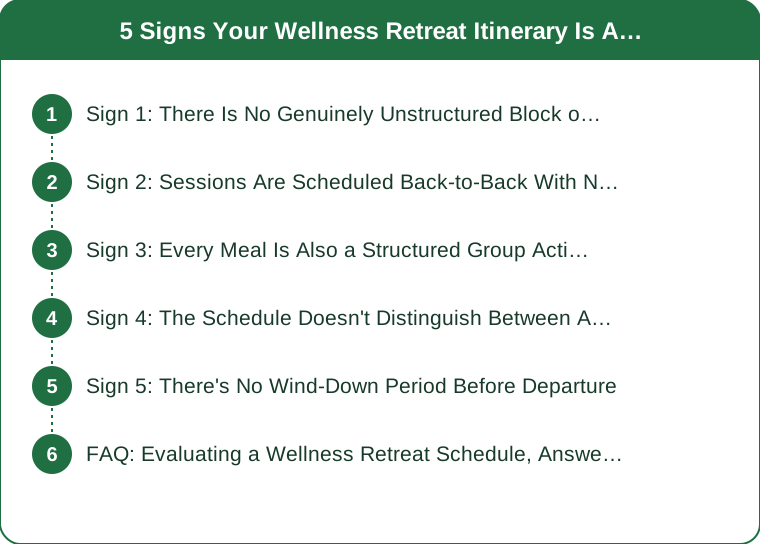
Sign 1: There Is No Genuinely Unstructured Block on the Schedule
Every hour of the day being assigned to some session, meal, or activity leaves no room for the kind of unstructured downtime that’s often where actual mental rest happens, regardless of how good the programmed sessions themselves are.
Sign 2: Sessions Are Scheduled Back-to-Back With No Buffer
Transitioning immediately from one session into the next without any buffer time creates a subtly rushed feeling throughout the day, even when each individual session is calm and well-run on its own.
Sign 3: Every Meal Is Also a Structured Group Activity
When even meals are treated as programmed social or educational sessions rather than simple, quiet breaks, guests lose one of the most natural built-in rest points a day normally provides.

Sign 4: The Schedule Doesn’t Distinguish Between Active and Restorative Sessions
A day that alternates only between different flavors of active programming, without clearly restorative blocks in between, can accumulate fatigue similarly to a demanding workday, just with a different set of activities.
Sign 5: There’s No Wind-Down Period Before Departure
Ending a retreat straight from a full final-day schedule into travel, without any buffer to mentally transition, often means the restorative effect fades quickly once guests are back in daily life.
FAQ: Evaluating a Wellness Retreat Schedule, Answered
Is it reasonable to ask a retreat organizer for the detailed hour-by-hour schedule before booking?
Yes — a legitimate retreat program should be able to share a fairly detailed schedule, and reviewing it for unstructured time is a reasonable, common part of choosing a retreat.
How much unstructured time is considered reasonable for a restorative retreat?
Many experienced retreat-goers look for at least a couple of hours of genuinely unstructured time per day, though this varies by personal preference and retreat type.
Does a packed schedule always mean a retreat won’t feel restful?
Not necessarily for everyone — some guests prefer a fuller schedule, but for those specifically seeking rest, unstructured time is one of the more reliable predictors of how restored they’ll actually feel afterward.
TL;DR:
- No unstructured time and back-to-back sessions both quietly undermine actual rest
- Meals treated as structured activities remove a natural built-in break point
- A schedule without a clear mix of active and restorative sessions can build fatigue
- Skipping a wind-down period before departure lets the retreat’s effect fade quickly
Keep Reading
This article is for general informational and styling purposes only. Fit, sizing, and product availability may vary.