5 Retreat Packing Choices That Change the Whole Week
Quick Answer: The standard packing list handles the obvious items and misses the five that matter: a layering system for a schedule that runs from cold dawn to warm afternoon, footwear for three distinct situations, one genuinely comfortable evening outfit, a small kit for the things venues never provide, and a deliberate plan for what you carry between sessions. Get these right and the week runs smoothly. Get them wrong and you spend it slightly cold, slightly uncomfortable, and repeatedly returning to your room.
Here are the five, in the order they will affect your day.
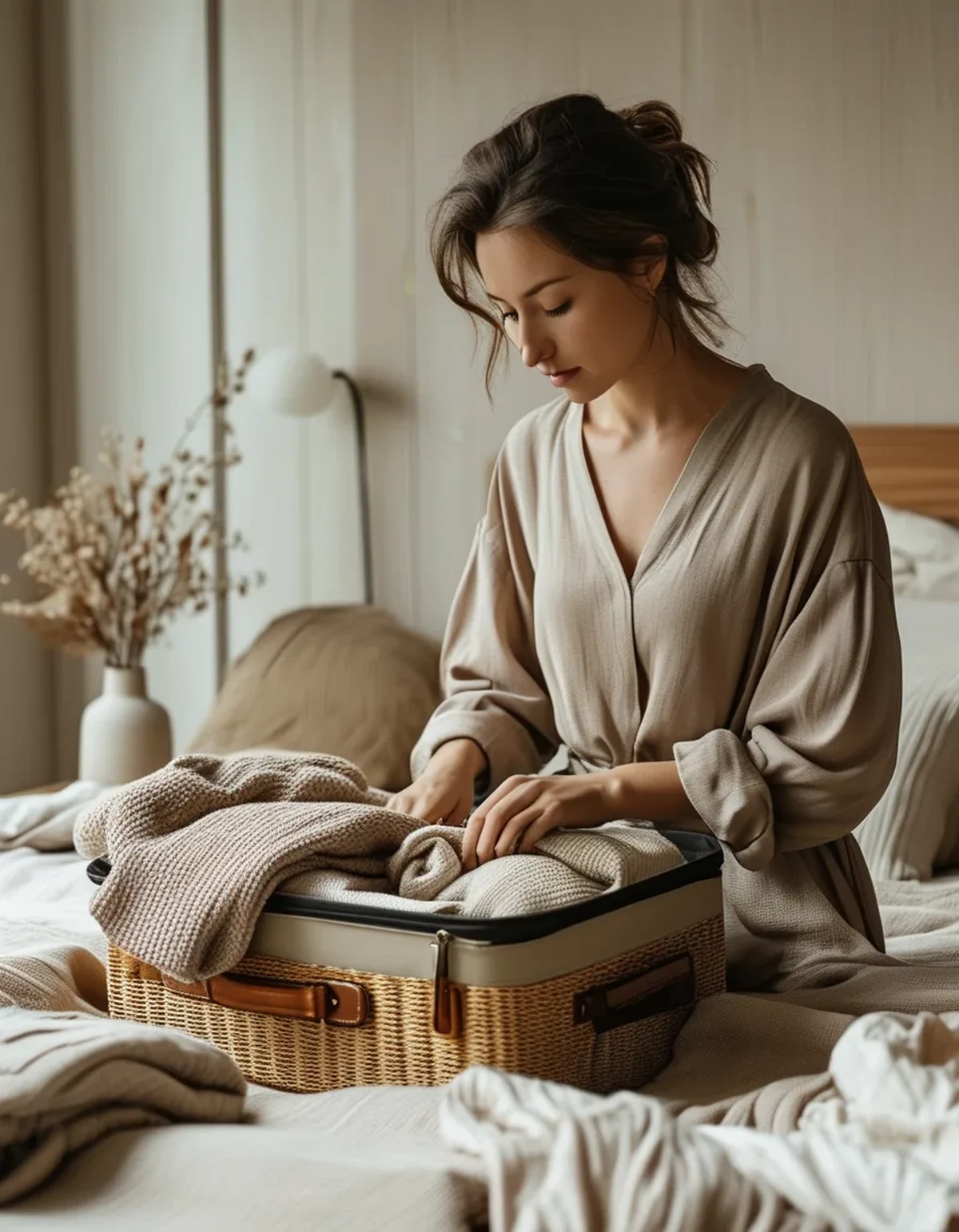
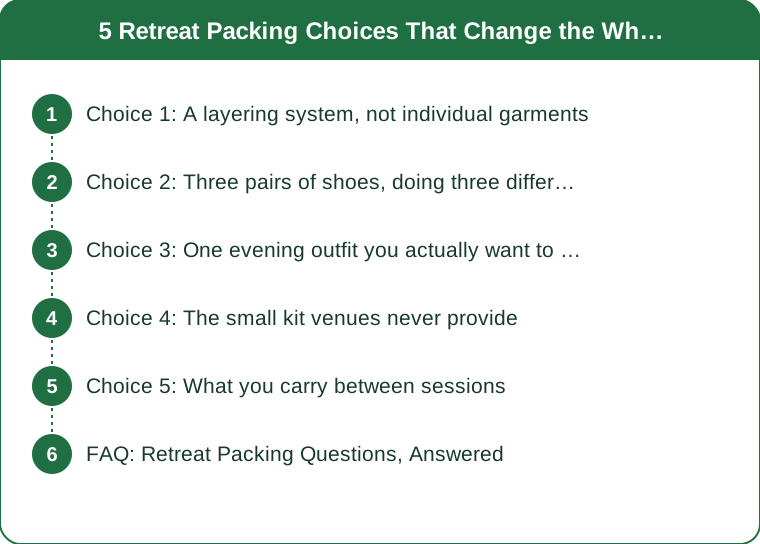
Choice 1: A layering system, not individual garments
A retreat day spans a wider temperature range than almost any normal day. A 6:30am session in a cool hall, mid-morning outdoors in full sun, a cool shaded lunch, an afternoon session that leaves you sweating, and an evening that drops sharply once the sun goes.
Pack a three-piece system rather than five separate tops. A close-fitting base layer, a mid layer you can pull on without changing, and one warm outer piece. All three in the same neutral family so any combination works.
The mid layer is the piece people forget and use most. A long-sleeve knit or light zip-up that goes on and off ten times a day without needing a mirror or a change of room.
Choose the base layers for morning cold, not afternoon warmth. You can always remove a layer; you cannot add one you did not bring, and morning sessions are consistently colder than people expect - stone floors, early hours, and a body that has not moved yet.
A large scarf or wrap earns its space several times over. Blanket in a cold morning session, layer at dinner, cover for a shoulder in a warm room. One item, four uses.
And bring one more warm layer than the forecast suggests. Sitting still for long periods - meditation, lectures, savasana - makes you far colder than the same temperature while moving.
Choice 2: Three pairs of shoes, doing three different jobs
The single most common footwear mistake is bringing two pairs that do the same job. Retreats have three distinct footwear situations and they do not overlap.
Slip-ons for the constant on-off. Most retreat spaces are shoes-off, and you will remove and replace them dozens of times a day. Anything with laces becomes genuinely tiresome by day two. Slides, clogs, or backless shoes.
Proper walking shoes for the outdoor sessions. Retreat schedules almost always include a walk, a hike, or an outdoor practice on uneven ground, and the grounds are rarely as manicured as the photographs suggest. Trainers with real grip, worn in beforehand.
Something warm for indoors. Cold floors are the most consistently underestimated discomfort at retreats - stone, tile, and polished wood in early mornings. Thick socks with grip, or soft indoor shoes, change the experience of every early session.
What to skip: anything with a heel, and anything not yet broken in. A retreat is the wrong week to discover a blister, and no retreat in the world requires a heel.
And pack shoes on the assumption of one rainy day. Wet walking shoes with no alternative is a genuinely miserable position to be in on day two of seven.
Choice 3: One evening outfit you actually want to wear
The failure mode is packing seven days of activewear and nothing else. Evenings at a retreat are social, unhurried, and the part of the day people most look forward to - and sitting through them in the leggings you practised in undermines the transition.
One relaxed, comfortable, non-athletic outfit does the work of several. A soft wide-leg trouser and a knit, or a simple jersey dress with a cardigan. Nothing formal, nothing that needs pressing, nothing that requires specific shoes.
The functional point is the psychological one: changing clothes marks the end of the working part of the day. That transition genuinely affects how restful the evening feels, and it costs one outfit’s worth of luggage space.
Choose a fabric that survives a suitcase. Jersey, knit, or a stable woven - anything that needs ironing is the wrong choice for a venue that will not have an iron.
One outfit, worn several times, is entirely fine. Nobody at a retreat is auditing your rotation, and this is one of the few contexts where wearing the same thing every evening is completely unremarkable.
Add one pashmina or oversized cardigan for the evening temperature drop and this choice is complete.
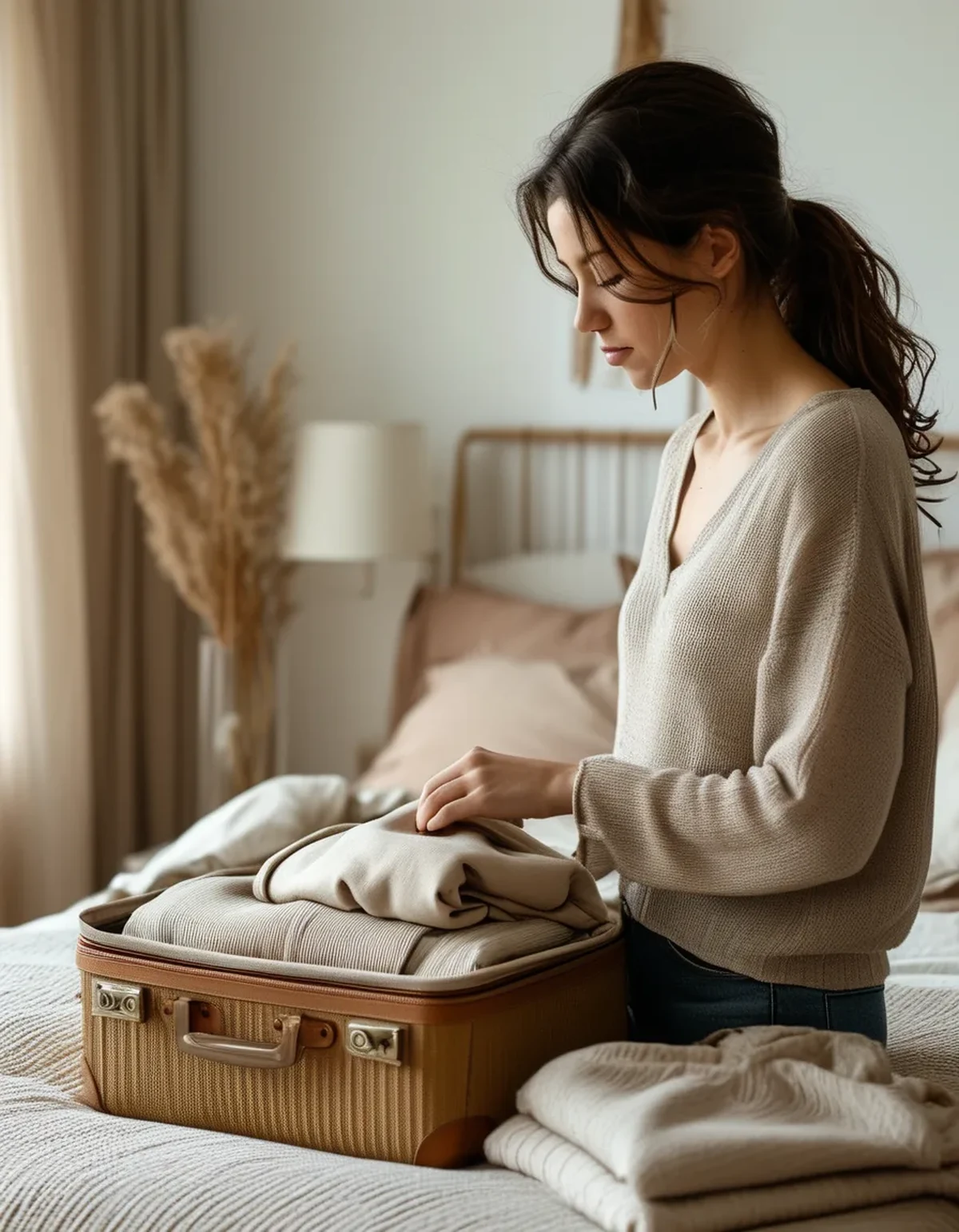
Choice 4: The small kit venues never provide
Every retreat venue provides towels, a mat, and a bed. The gaps are consistent and small.
A refillable water bottle with a wide mouth. You will be reminded to hydrate constantly and the water stations are rarely near your room. Wide mouth so it is easy to fill from a jug or a tap.
Earplugs and an eye mask. Shared walls, unfamiliar sounds, early light, and possibly a roommate. These two items are the difference between sleeping well for a week and not, and they weigh nothing.
A small torch or headlamp. Rural venues, unlit paths, and early morning starts in the dark - particularly relevant as the season moves on and mornings get darker. Your phone works and is worse.
Basic first aid: blister plasters, painkillers, antihistamines, and any personal medication in a quantity beyond the trip length. Remote venues are remote, and the nearest pharmacy may be forty minutes away.
A notebook and a pen. Retreats generate more thoughts than people expect, and phone notes pull you into a device you were probably trying to step away from.
And a laundry bag or a couple of plastic bags. Damp practice clothes and clean clothes in the same case for seven days is a small, entirely avoidable problem.
Choice 5: What you carry between sessions
You will move between your room and the practice space many times a day, and the distance is often further than it looks in the photographs. The decision of what travels with you determines how many of those trips you make.
One small bag that holds everything for a half-day. Water bottle, mid layer, socks, notebook, lip balm, hair tie. A soft tote or small backpack that folds flat in the suitcase.
The test: can you leave your room after breakfast and not need to return until lunch? If not, you are making four extra trips a day, and those trips are where the rushing and the low-level stress come from.
Bring your own mat only if you have a strong preference. Almost all retreats provide them, and a mat is bulky. A mat towel or a small strap is a better use of the space if you want something of your own.
Keep the bag packed the night before. Early sessions start early, often before full daylight, and packing in the dark at 6am is exactly the kind of small friction a retreat is meant to remove.
And leave room in the suitcase for the way home. Retreats have shops, and you will come back with something - a book, a blanket, something from a local market. Ten percent of empty space solves it.
These five choices together are perhaps four extra items over a standard packing list, and they remove nearly every recurring small annoyance of a retreat week.
FAQ: Retreat Packing Questions, Answered
How much should I actually pack?
Far less than instinct suggests. Most retreat days involve two outfits - practice clothes and evening clothes - and laundry is often available. Four sets of practice clothes for a week is plenty, and you will wear the same evening outfit repeatedly without anyone noticing.
Do I need to bring my own mat and props?
Usually not - check the venue’s list first, since almost all provide mats, blocks, straps, and blankets. Bring your own only for a strong personal preference, and consider a mat towel as the lighter compromise.
What is the most commonly forgotten item?
Warm layers for sitting still, and a torch. People pack for the temperature during movement rather than during forty minutes of stillness, and they assume the venue paths are lit. Both are corrected easily and matter every single day.
TL;DR:
- Pack a three-piece layering system in one neutral family, not five separate tops.
- Three pairs of shoes doing three jobs: easy slip-ons, real walking shoes, and something warm for cold floors.
- One comfortable evening outfit marks the transition and does more than its luggage space suggests.
- The small kit: bottle, earplugs and eye mask, torch, basic first aid, notebook, laundry bag.
- One day bag packed the night before, so you never make an extra trip back to your room.
Start with the layering system - it is the choice that affects every hour of every day.
Keep Reading
This article is for general informational and styling purposes only. Fit, sizing, and product availability may vary.