5 Retreat Mornings and What Each One Actually Sets Up for the Rest of the Day
Quick Answer: Retreat mornings come in roughly five formats - silent, early movement, late slow start, structured workshop, and open unscheduled - and each one determines the shape of the rest of the day. A silent morning makes the afternoon feel spacious; a 6am movement block makes it feel earned but often produces a 3pm crash. Read the morning block on any itinerary before anything else, because it is the part you cannot opt out of without missing the whole design.
The brochure photograph is always the afternoon.
The morning is the thing you actually booked.

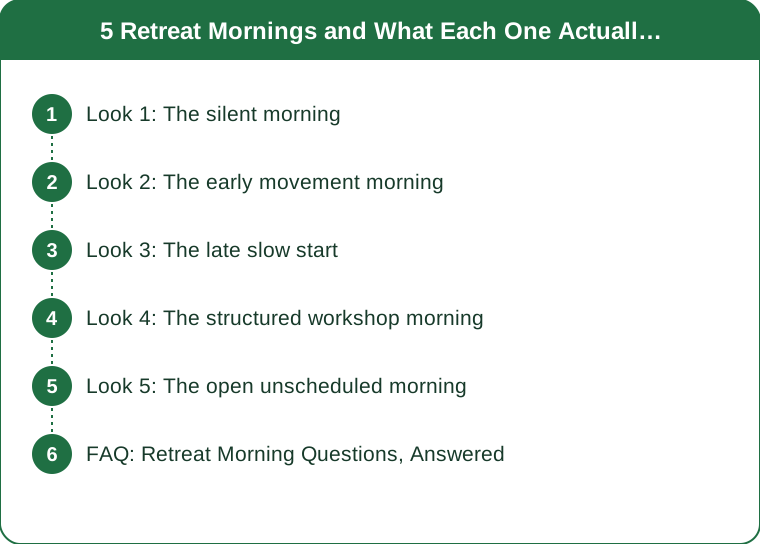
Look 1: The silent morning
Format: no talking from waking until after breakfast, sometimes until a mid-morning session.
What it sets up: an afternoon that feels far longer than it is. Removing conversational input early in the day noticeably slows the perceived pace of everything after it.
Who it suits: anyone whose ordinary mornings are a stream of messages, questions and logistics. The contrast is the point, and it is largest for people with the noisiest normal.
What people find hard: the first morning, almost universally. Silence with strangers is uncomfortable before it is restful, and most people report the second morning being completely different.
What to pack for it: a notebook. Silent mornings generate thoughts with nowhere to go, and writing them down is what stops you spending the silence rehearsing them.
The failure mode: treating the silence as a rule to comply with rather than a condition to use. People who spend it on their phone get the restriction without the benefit.
Look 2: The early movement morning
Format: a 6 or 6.30am yoga, hike or swim before breakfast.
What it sets up: a day that feels productive from the start, and an energy dip that usually lands mid-afternoon. If the schedule puts a workshop at 3pm, this morning format works against it.
Who it suits: people who already wake early and would otherwise spend the morning waiting for something to happen.
What people find hard: the second and third days, cumulatively. One 6am start is invigorating; four in a row on unfamiliar sleep is a different experience entirely.
What to pack for it: layers you can shed, and a real breakfast strategy - early movement on an empty stomach followed by a large late breakfast is what produces the afternoon crash.
The failure mode: doing every optional early session because it is included. Two of four is usually the version people say they wish they had chosen.
Look 3: The late slow start
Format: nothing scheduled before 9.30 or 10am, with breakfast open across a long window.
What it sets up: the most genuinely restorative day of the five, and the one people most often describe as wasted while they are in it.
Who it suits: anyone arriving from a long stretch of accumulated sleep debt, which is a large share of retreat attendees and rarely acknowledged in the marketing.
What people find hard: the guilt. A slow morning at a retreat you paid for reads as under-using the thing, which is why so many people fill it with optional extras.
What to pack for it: something to do with your hands that is not a phone - a book, a sketchbook, a pack of cards.
The failure mode: treating the unscheduled morning as a scheduling error and asking what else is available. The empty block is the product.

Look 4: The structured workshop morning
Format: a facilitated session of 90 minutes to three hours, usually the intellectual core of the retreat.
What it sets up: an afternoon of processing, which is why good retreats put movement or free time after it rather than a second workshop.
Who it suits: people who want to leave with something specific - a practice, a plan, a framework - rather than only a rested feeling.
What people find hard: the density. Three hours of new material before lunch on day two, when you are still sleeping badly in an unfamiliar bed, is more demanding than the schedule implies.
What to pack for it: a pen you like and a way to record. The single most common post-retreat complaint is remembering that something was useful without remembering what it was.
The failure mode: two workshop mornings back to back with no gap for the first to settle.
Look 5: The open unscheduled morning
Format: several optional activities running simultaneously, nothing required.
What it sets up: either the best or worst day of the retreat, depending entirely on whether you decide the night before.
Who it suits: returning attendees who already know what they want from the place, and people travelling with someone whose preferences differ from theirs.
What people find hard: the choosing. An open morning with five options costs more decision energy than a fixed schedule, which is the opposite of what most people came for.
What to pack for it: nothing special - but decide the evening before, in writing, and treat it as fixed.
The failure mode: spending the morning deciding, then joining something late and half-heartedly. Open mornings reward a decision made the night before more than any other format.
FAQ: Retreat Morning Questions, Answered
Which morning format is best for a first retreat?
A late slow start or a light structured morning. Early 6am blocks and full silence are both more demanding than they appear when you are also adjusting to a new bed and an unfamiliar place.
Should I do every optional morning session?
Usually not. Most people who do report exhaustion by day three. Choosing roughly half is the pattern people say worked in retrospect.
Why do I feel worse on day two?
A combination of unfamiliar sleep, travel, and often a sharp change in caffeine or schedule. Day two being the low point is extremely common and it generally resolves.
How do I stop a slow morning feeling like wasted money?
By recognising that unstructured time is the scarce resource you actually bought. Bringing something non-digital to do with your hands helps enormously.
What is the one thing to check on an itinerary before booking?
The morning block, and whether afternoons have real gaps. A schedule that is full from 6.30am to 9pm is a programme, not a retreat.
How do I keep any of it after I get home?
Pick one element of the morning you liked and make a ten-minute home version. Attempting to import the whole schedule is why post-retreat routines rarely survive a fortnight.
TL;DR:
- The morning block, not the afternoon photos, determines what a retreat day feels like.
- Silent mornings make afternoons feel spacious; 6am movement blocks often produce a 3pm crash.
- Unscheduled slow mornings are the most restorative and the most frequently mistaken for wasted time.
- Workshop mornings need a gap afterwards to settle rather than a second session.
- Open mornings reward deciding the night before, in writing.
- Choose roughly half the optional sessions, not all of them.
Read the morning block first. It is the part of the itinerary you cannot skip without missing the design.
Keep Reading
This article is for general informational and styling purposes only. Fit, sizing, and product availability may vary.