5 Retreat Moments That Decide How the Whole Week Feels
Quick Answer: Five moments carry disproportionate weight on a retreat: the first two hours after arrival, the first morning session, the midweek slump, the first unstructured afternoon, and the last evening. Each one is a hinge — handled well, the days around it improve; handled badly, they set a pattern that persists. None of them appear on a schedule, which is precisely why they catch people out.
Here is what happens at each and what to do with it.

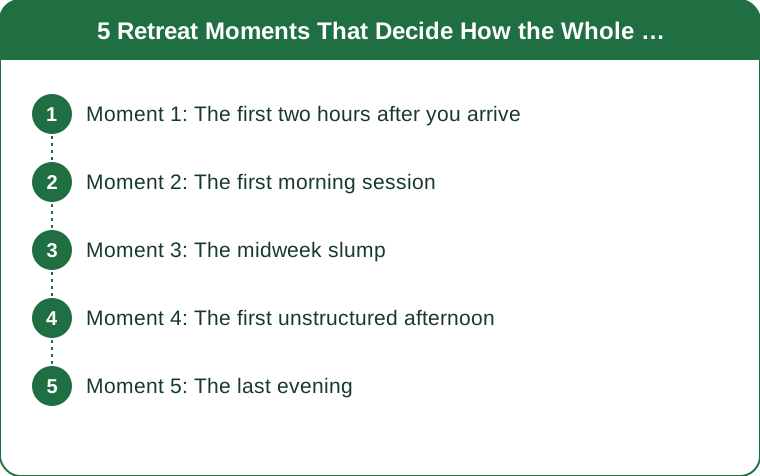
Moment 1: The first two hours after you arrive
This is the moment that sets your relationship with the entire place, and it is almost always mishandled.
You arrive tired from travel, in an unfamiliar environment, surrounded by strangers, usually with a welcome session scheduled within the hour. The instinct is to be sociable and to start participating immediately, because that is what you came for and because staying in your room feels antisocial.
That instinct produces a specific problem. You spend your first two hours in high-effort social mode while genuinely depleted, and by dinner you are exhausted for reasons that have nothing to do with the retreat’s content.
The better approach is deliberately unglamorous. Unpack fully, drink water, and take twenty minutes alone before you meet anyone. Walk the grounds, find where things are, locate the quiet spot you will want later.
That twenty minutes does two things. It converts an unfamiliar place into a known one, which removes a low-grade cognitive load that otherwise runs all week. And it means you arrive at the welcome session as a rested person rather than a travelling one.
The people who report the best retreat experiences are, consistently, the ones who did not treat arrival as the start of the programme.
Moment 2: The first morning session
The first morning is where you decide, usually unconsciously, whether you are here to perform or to participate.
Almost every retreat opens with a session that is more demanding than it needs to be — a long yoga practice, an early meditation, a hike. You are jet-lagged or road-tired, you slept badly in an unfamiliar bed, and everyone else looks capable.
The decision made in this session tends to persist for the week. People who push hard on day one to keep up establish a pattern of pushing, and by day four they are depleted and quietly resentful. People who take the first session at genuinely reduced effort establish permission to modify, and they are usually the ones with energy left on day five.
Taking the first session at about 70 percent is the single most useful decision on a retreat. Sit out a round. Take the easier variation. Leave early if you need to.
This is harder than it sounds because of the social context. Everyone is watching everyone, nobody wants to be the first to modify, and the group calibrates to whoever is most enthusiastic.
Being the person who modifies on day one is quietly a gift to everyone else, because it gives the whole group permission. It is also the choice that protects the rest of your week.

Moment 3: The midweek slump
Around day three or four, something predictable happens and almost nobody is warned about it.
The novelty has worn off. The initial energy of arrival is spent. Whatever you were carrying from home — stress, tiredness, an unresolved situation — has caught up with you now that there is space for it. Retreats reliably produce a low point somewhere in the middle, and it is a feature of the process rather than a sign that the retreat is not working.
Physically, this is often when accumulated fatigue from unfamiliar activity peaks. Emotionally, it is when the decompression that the retreat is designed to produce actually starts, and decompression is not always pleasant.
The common reactions are both unhelpful. Some people push harder, adding sessions and activity to outrun the feeling. Others withdraw completely and lose the rest of the week.
The useful response is to reduce and stay engaged. Do the gentle session rather than the demanding one. Keep showing up and lower the effort. Talk to someone — a facilitator, another guest — because the slump is nearly universal and naming it removes most of its weight.
Knowing it is coming is worth a great deal. People who expect a midweek dip navigate it in a day; people who are blindsided by it often lose two or three.
Moment 4: The first unstructured afternoon
Most retreats include free time, and free time is where the retreat either does its real work or quietly fails.
The scheduled sessions are the visible part. The unstructured hours are where whatever the sessions opened up either settles or gets papered over.
What usually happens is that free time gets filled — with the phone, with an excursion, with organizing a group activity, with catching up on work. All of these are comfortable and all of them are avoidance.
The more valuable use is genuinely unstructured. A walk with no destination. Sitting somewhere with no input. A long, slow meal. Reading something unrelated to anything.
This is also where the phone question actually gets decided. Nobody uses their phone during a facilitated session; everybody has the option during free time. A retreat where the free afternoons are spent scrolling is a retreat that delivered five hours of content and no integration.
One practical suggestion: decide what the first free afternoon will be before it arrives. Not a plan exactly, but an intention — a walk, a swim, a nap. Deciding in the moment, while tired and with a phone in your pocket, reliably produces the default rather than the choice.
Moment 5: The last evening
The final evening determines what survives the return home, and it is usually spent on the wrong thing.
What typically happens: a closing dinner, exchanging contacts, talking about the week, staying up late. It is warm and social and entirely understandable, and it means the last conscious hours of the retreat are spent in exactly the mode you came to escape.
The post-retreat crash is well documented — people return home elevated, hit ordinary life within 48 hours, and experience a sharp drop. A large part of that is that no transition was built, and the last evening is where a transition would have gone.
What is worth doing instead, or alongside:
Write down three specific things you want to keep, in concrete terms. Not insights — practices. The morning ten minutes. The walk before dinner. The phone staying in another room during meals.
Decide which single one you will do on your first day home. One, not three. The people who keep something are usually the ones who chose one thing.
Go to bed at a reasonable hour. Arriving home exhausted guarantees that the first day back overwhelms whatever you were carrying.
Then join the closing dinner. This takes fifteen minutes and it is the difference between a memorable week and a week that changes something.
The honest summary of a retreat: the sessions provide the material, and these five moments decide whether any of it takes.
TL;DR:
- The first two hours: unpack and take twenty minutes alone before meeting anyone — it converts an unfamiliar place into a known one.
- The first morning session: take it at about 70 percent, which sets the week’s pattern and gives the whole group permission to modify.
- The midweek slump around day three or four is near-universal; reduce effort but stay engaged rather than pushing or withdrawing.
- The first free afternoon: decide the intention in advance, or the default takes it.
- The last evening: write down three concrete practices, pick one for your first day home, and sleep properly.
None of these are on the itinerary, which is exactly why they are worth planning for.
Keep Reading
This article is for general informational and styling purposes only. Fit, sizing, and product availability may vary.