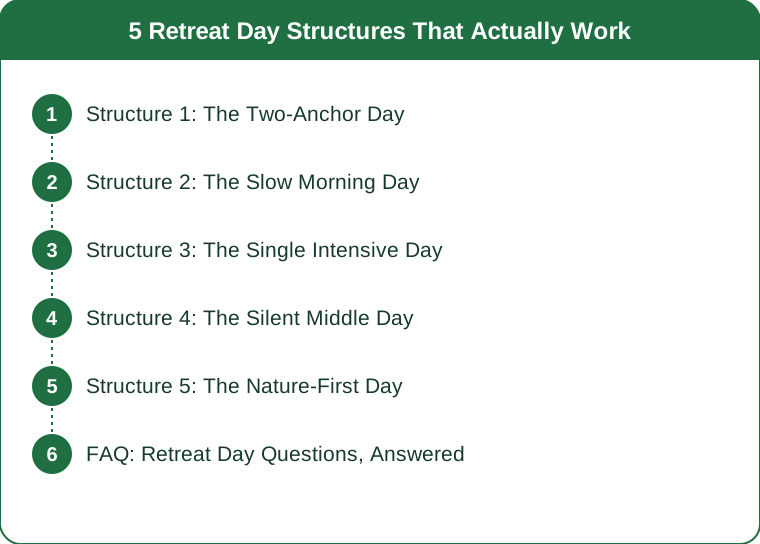
5 Retreat Day Structures That Actually Work
Quick Answer: The retreat days that leave people genuinely restored share one feature: a single anchor activity plus a large, protected block of unstructured time. The five structures below — Two-Anchor, Slow Morning, Single Intensive, Silent Middle, and Nature-First — each organize a day around that principle in a different way. Any of them can be run at a retreat centre or at home over a weekend.
Most retreat schedules are dense. Sunrise yoga, breakfast, workshop, lunch, second practice, treatment, dinner, evening circle. It reads like value and it produces people who go home exhausted.
A restorative day has a shape, not a schedule. These five shapes work, and each one suits a different kind of tiredness.
Pick the one that matches what you are actually depleted of.

Structure 1: The Two-Anchor Day
Two scheduled activities — one in the morning, one in the late afternoon — and absolutely nothing between them.
How it runs: a movement practice at around 8am, then a genuinely open stretch from 10am to 4pm, then something quieter like a restorative session or a slow walk before dinner. Meals happen when you are hungry rather than at a bell.
Why it works: two anchors are enough to give the day structure and momentum without ever putting you in the position of watching a clock. The six-hour middle is long enough that you stop planning and start drifting, which is where the actual rest happens.
Best for: general burnout and decision fatigue. If your tiredness comes from a job full of small decisions, this is the one — because the middle of the day asks you to make none.
At home: a morning class or long walk, an early-evening stretch or bath, and a deliberately empty middle with your phone in another room. Say no to one social thing to protect it.
Structure 2: The Slow Morning Day
Nothing scheduled before noon. The entire first half of the day is protected.
How it runs: wake without an alarm, make coffee slowly, read, sit outside, eat when hungry. The first commitment is a midday or early-afternoon session, then the evening is loose again.
Why it works: most people’s stress is concentrated in the morning — the alarm, the rush, the immediate demands. Removing the morning entirely addresses that directly, and unhurried mornings are what people most often describe as the thing they miss.
Best for: anyone whose exhaustion is about pace rather than volume. If you are not doing too much but are always rushing, this is the corrective.
At home: the easiest structure to replicate and the one people most often skip. No alarm, no phone before you have eaten, nothing scheduled before noon. One weekend day is enough to feel the difference.
Structure 3: The Single Intensive Day
One substantial, absorbing activity — three to four hours — and the rest of the day genuinely free.
How it runs: a long hike, a full workshop, a cooking or pottery session, or an extended practice. It occupies real time and attention, and then it is over and the day is yours.
Why it works: deep absorption in one thing produces a particular kind of restoration that fragmented activities do not. Three hours in one activity is qualitatively different from three one-hour activities, and the recovery afterward feels earned rather than idle.
Best for: mental restlessness. If unstructured time makes you anxious rather than relaxed, this gives your mind something substantial to hold before letting go.
At home: a long hike, a full day of cooking something ambitious, or a class you have been meaning to take. The rule is that nothing else gets scheduled that day.

Structure 4: The Silent Middle Day
Talking in the morning and evening; a silent block of four to six hours in the middle.
How it runs: breakfast and conversation as normal, then silence from mid-morning until late afternoon — no talking, no phone, no music with words. Walk, sit, write, or nap. Then dinner and conversation again.
Why it works: conversation is a genuine cognitive load, and most people never remove it for long enough to notice. A partial silent block delivers most of the benefit of a silent retreat without the intimidating commitment, and the evening conversation afterward is noticeably different.
Best for: social fatigue and overstimulation. If you have been in meetings and group settings for weeks, this targets exactly that.
At home: harder if you live with others, so agree it in advance rather than announcing it. Four hours is plenty for a first attempt, and a written note beats an explanation.
Structure 5: The Nature-First Day
Every scheduled element happens outdoors, and the day is organized around light rather than clock time.
How it runs: outside within thirty minutes of waking, the main activity outdoors in the morning, lunch outside, an easy afternoon in shade, and outside again as the light drops. Nothing indoors except sleeping and weather.
Why it works: morning light exposure is one of the most reliable levers on sleep quality and mood, and time in green space is consistently associated with reduced stress markers. Organizing the day by light rather than by hours also breaks the clock-watching habit that follows people onto retreats.
Best for: poor sleep and low mood. If your main complaint is that you sleep badly, this structure targets the mechanism most directly.
At home: eminently doable. Coffee outside, a morning walk, work or read outdoors if you can, and be outside again at sunset. Of the five, this is the one with the clearest evidence behind it and the lowest barrier to trying.
FAQ: Retreat Day Questions, Answered
How do I choose between these?
Match the structure to what depleted you. Decision fatigue points to Two-Anchor, rushing to Slow Morning, restlessness to Single Intensive, social overload to Silent Middle, and poor sleep to Nature-First. If you cannot tell, start with Nature-First — it helps most people.
Can I combine them across a weekend?
Yes, and it is a good approach for a two or three day break. A common sequence is Nature-First on day one, Slow Morning on day two, and Silent Middle on day three. Do not try to combine two in a single day — the empty space is the active ingredient in all of them.
What if a booked retreat has a packed schedule?
Choose which sessions to skip before you arrive, and tell someone so you do not talk yourself back into all of them. Nearly every retreat schedule is designed as an offering rather than a requirement, and the guests who leave most rested are usually the ones who attended less.
This is general wellbeing information, not medical advice.
TL;DR:
- Every genuinely restorative retreat day has one anchor activity plus a large protected block of unstructured time.
- Two-Anchor Day: two sessions, a six-hour empty middle. Best for decision fatigue.
- Slow Morning Day: nothing before noon. Best for feeling constantly rushed.
- Single Intensive Day: one absorbing three to four hour activity, then nothing. Best for mental restlessness.
- Silent Middle Day: four to six hours of no talking in the middle. Best for social overload.
- Nature-First Day: everything outdoors, organized by light rather than clock. Best for poor sleep — and the best-supported of the five.
- All five work at home over a weekend, and the empty space is the active ingredient in every one.
Retreat schedules get judged by how much they contain, which is exactly the wrong metric. Pick a shape that matches what has actually worn you out, protect the gap in the middle, and a single day at home can do more than a packed week away.
Keep Reading
This article is for general informational and styling purposes only. Fit, sizing, and product availability may vary.