5 Conversations That Decide What You Actually Bring Home From a Retreat
Quick Answer: Retreat outcomes correlate more with a handful of specific conversations than with the itinerary. Seek out five: one with a teacher about your actual situation, one with a stranger who has already changed something, one honest group moment, one with yourself in writing, and one before you go home about what changes.
You remember the sunrise session and the food.
Six months later, what actually changed usually traces back to something someone said on a terrace.

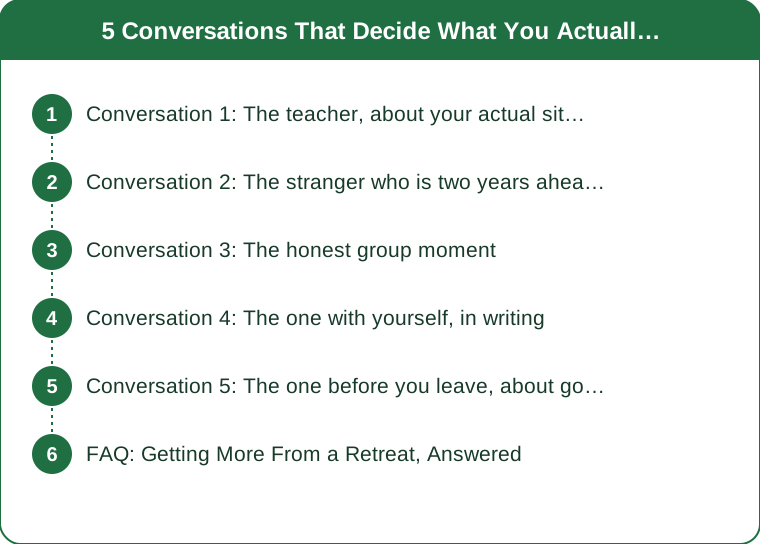
Conversation 1: The teacher, about your actual situation
Most people take a class and leave without ever telling the teacher what is genuinely going on — the injury, the schedule, the reason they came. The general instruction is designed for the room, not for you.
Five minutes after a session, describing your real constraints, converts generic teaching into something specific. Teachers at retreats have far more time than in a studio and are usually glad to use it.
Ask a narrow question rather than a broad one. ‘How do I keep this going with three days a week and a bad back?’ produces something useful. ‘Any advice?’ produces a pleasantry.
Conversation 2: The stranger who is two years ahead of you
Every retreat has someone who made a change like the one you are considering and is now living with the results. They are the most valuable source in the building and nobody has a session scheduled with them.
Find them at meals rather than in sessions. The question that opens it: ‘What did you actually change when you got home, and what stuck?’
Expect the answer to be smaller than you hoped. The changes that survive are almost always modest, and hearing that from someone who lived it lands differently than reading it.
Conversation 3: The honest group moment
Most group sharing stays comfortable. Occasionally someone says something genuinely true and the register of the room shifts. That moment is where a lot of the retreat’s actual value lives.
You cannot schedule it and you can make it more likely by going first. Saying something slightly more honest than the room expects usually gives everyone else permission.
If the group format never gets there, one honest conversation with a single person over dinner does the same job. Both work; the group version is just rarer.

Conversation 4: The one with yourself, in writing
The reflective session most people skip, or do in their head while half-asleep. Writing changes what you notice — vague intentions become sentences that are either true or not.
Do it on day three, not day one. Day one produces the intentions you arrived with. Day three produces the ones the week actually surfaced.
Three questions are enough: what did I stop doing here that I want to keep not doing, what did I start that I want to keep, and what will realistically survive a Tuesday in November.
Conversation 5: The one before you leave, about going home
The post-retreat crash is well documented and largely preventable. It comes from the gap between an environment designed for wellbeing and a life that is not, hitting with no plan for the transition.
Have the conversation before you leave — with a teacher, with someone you met, or with whoever is at home. Name one thing that changes and one thing that does not.
The realistic version is small: a 20-minute morning practice, a phone rule after 9pm, one evening a week protected. Ambitious plans made in a beautiful place have a poor survival rate, and knowing that in advance is what makes the modest version acceptable rather than disappointing.
FAQ: Getting More From a Retreat, Answered
What if I am shy and the group format is uncomfortable?
You do not need the group. One honest conversation over a meal accomplishes the same thing, and most retreats have plenty of unstructured time for it. The structured sharing session is one route to the outcome, not the outcome itself.
How do I avoid the post-retreat crash?
Plan the first week home before you leave. A specific, small commitment — one 20-minute practice, one protected evening — gives the transition something to land on. The crash comes from the absence of a plan more than from the change of scenery.
Are the expensive retreats better for this?
Not particularly. These five conversations are available at almost any price point, because they depend on the people present rather than the facilities. What money reliably buys is comfort, food, and setting, which are real but different things.
TL;DR:
- Retreat outcomes track a few conversations more than they track the itinerary.
- Ask the teacher a narrow question about your real constraints, and find the person who is two years ahead of you.
- Write your reflection on day three rather than day one, when the week has actually surfaced something.
- Plan the first week home before you leave, and keep the commitment small enough to survive November.
The schedule fills the week. The conversations are what get on the plane with you.
Keep Reading
This article is for general informational and styling purposes only. Fit, sizing, and product availability may vary.